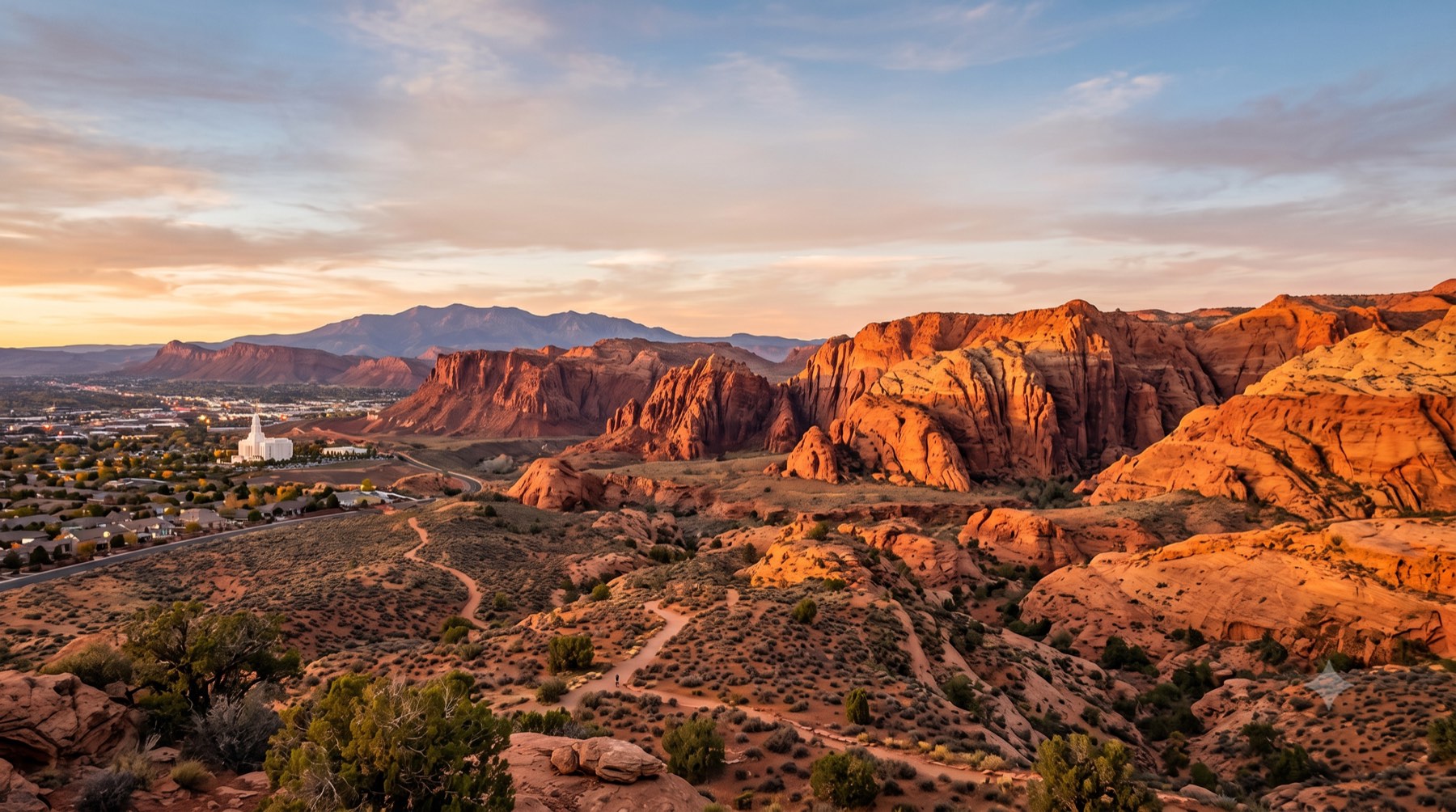
Washington County · Utah · Covered downwind area
St. George sat directly under the fallout path of the Nevada Test Site through the 1950s. If you or a family member lived here during the testing period and later developed a covered cancer, a $100,000 federal payment may be available — including for families whose relative has already passed away.
Coverage
Washington County was named in the original 1990 law; today all of Utah is covered.
Presence window
Generally 1 year between Jan. 21, 1951 – Nov. 6, 1962, or all of June 30–July 31, 1962.
Survivors
Spouses, children & eligible heirs may file.
Every downwinder claim comes down to the same three questions. Location is the easy one for St. George — the other two are where most families need help.
Between 1951 and 1962 the federal government detonated roughly a hundred above-ground nuclear devices at the Nevada Test Site, about 135 miles west of St. George. Prevailing winds carried the debris clouds northeast, directly over Washington County. The town had fewer than 6,000 residents at the time, and almost all of them were outdoors, in school, or working livestock when the clouds passed.
The clearest example came on May 19, 1953. The shot later nicknamed "Dirty Harry" produced fallout heavy enough that residents were advised to stay indoors as the cloud moved across the city — the only such advisory many families ever received. Weeks later, thousands of sheep grazing between Nevada and southern Utah sickened and died, and ranchers who raised the alarm were told there was no connection.
Decades of congressional hearings, health studies, and litigation followed, and St. George became the reference community for downwind exposure. That history is exactly why Washington County was named in the original 1990 Radiation Exposure Compensation Act — and why a claim from a St. George family starts on solid ground.
The people who were children then are in their seventies and eighties now. Many of the claims we prepare today are filed by their sons, daughters, and grandchildren.
Do not send full medical records through any website form. Intake collects only basic screening details; sensitive documents are handled through a secure document workflow.
Proving Residency
The DOJ wants documents, not recollections. These are the Washington County sources that most often produce a usable record. You do not need all of them — usually two or three independent documents are enough, and we request them on your behalf.
Deeds, mortgages, and property tax rolls from the 1950s. A parcel in a parent's or grandparent's name across consecutive tax years is among the strongest single documents a claim can carry.
Enrollment cards, attendance registers, and cumulative student records. If the claimant was a child in St. George, this is usually the fastest path to a dated, year-over-year record.
Membership, baptism, and ward-transfer entries are often the only continuous year-by-year record of where a southern Utah family lived. Accessible through FamilySearch and the Church History Library in Salt Lake City.
Birth and death certificates naming a St. George address, county census and voter rolls, and institutional records held in Salt Lake City rather than locally.
Diagnosis proof is a separate requirement. Records from the hospital and clinics serving St. George — plus later treating facilities anywhere in the country — can be requested even for a relative who has died, with the right authorization.
City directories, utility connection records, and dated newspaper mentions — school honor rolls, church notices, obituaries. Southern Utah University and Utah State University hold regional collections that fill 1950s gaps.
Federal employment, Social Security earnings statements, and military records also establish residency and are often faster to obtain than county records. Tell us what you already have and we will identify the shortest remaining path.
Covered Conditions
You do not need to prove fallout caused the cancer. The claim file must document the eligible area, period, and diagnosis. See how a diagnosis fits →
Local Questions
Yes. Survivor claims are a core part of the program. A surviving spouse, children, or other eligible heirs may file on behalf of a deceased downwinder, and there is no requirement that the death be recent. The claim needs her residency proof, her diagnosis records, and documentation of the family relationship.
It can. The presence requirement applies to the covered area, not to one town. Because the 2025 reauthorization made all of Utah a covered downwind area, time in St. George and Cedar City can be combined toward the same qualifying period.
No. Almost none of our claimants start with documents in hand. Residency is nearly always rebuilt from third-party records — county property and tax rolls, school enrollment, ward membership entries, Social Security earnings, and state vital records. That reconstruction is the work we do.
Often, yes. Many older denials turned on documentation gaps or on coverage boundaries that the 2025 reauthorization has since widened. We review the prior denial letter first and tell you plainly whether anything has changed.
No. Records requests, document review, and filing are handled remotely by phone, mail, and secure upload. Most of the families we work with no longer live in Utah.
The program's filing deadline is December 31, 2027. Building a residency file from 1950s county and church records regularly takes several months, so the practical deadline for starting is well before that date.
More general questions — cost, legitimacy, what happens after the check — are answered on the common questions page. Helping a parent file? Start here.
A short check, no cost, no obligation. If the claim does not hold up, we will tell you that too.
Source: U.S. Department of Justice RECA downwinder affected-area guidance. This page is informational and does not determine final eligibility.
Prefer paper? Print this page and call 1-866-356-7322 when you're ready.